In today's fast-paced world, more and more people are looking for ways to relieve stress, restore emotional balance, and reconnect with themselves. One practice that combines creativity, inner silence, and mindfulness is meditative painting.
It is not an academic art technique and does not require prior knowledge. Meditative painting is a process in which brushstrokes become the rhythm of breathing, colors become the language of emotions, and the creative path becomes a form of self-discovery.
This is exactly the approach that the philosophy of Paintnprogress.art resonates with - art as a process, not just a result.
Meditatīvās gleznošanas nodarbība piektdienas vakaros
Check out all current offers, trips and painting master classes:
What does it mean to paint meditatively?
Meditative painting is not about perfection or achieving a certain result. It is based on presence and acceptance.
In this process, it is important to:
- to be conscious in the very creative moment
- observe your feelings, not judge them
- to allow the hand to move freely
- to follow what arises spontaneously
When painting meditatively, thoughts gradually become quieter, movements become smoother, the rhythm of the hand merges with the breath, and the colors help open the space of the subconscious.
It is an opportunity to listen to yourself, express emotions in a safe form, and transform tension into a creative flow.
Mandala as a structure of inner balance
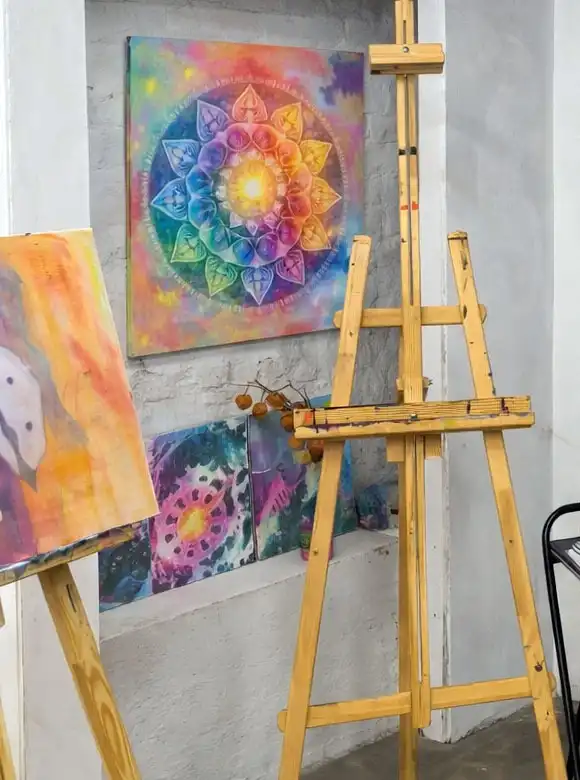
The mandala is often used in meditative painting as a support form that helps to focus and maintain structure. It symbolizes balance, harmony, and inner center.
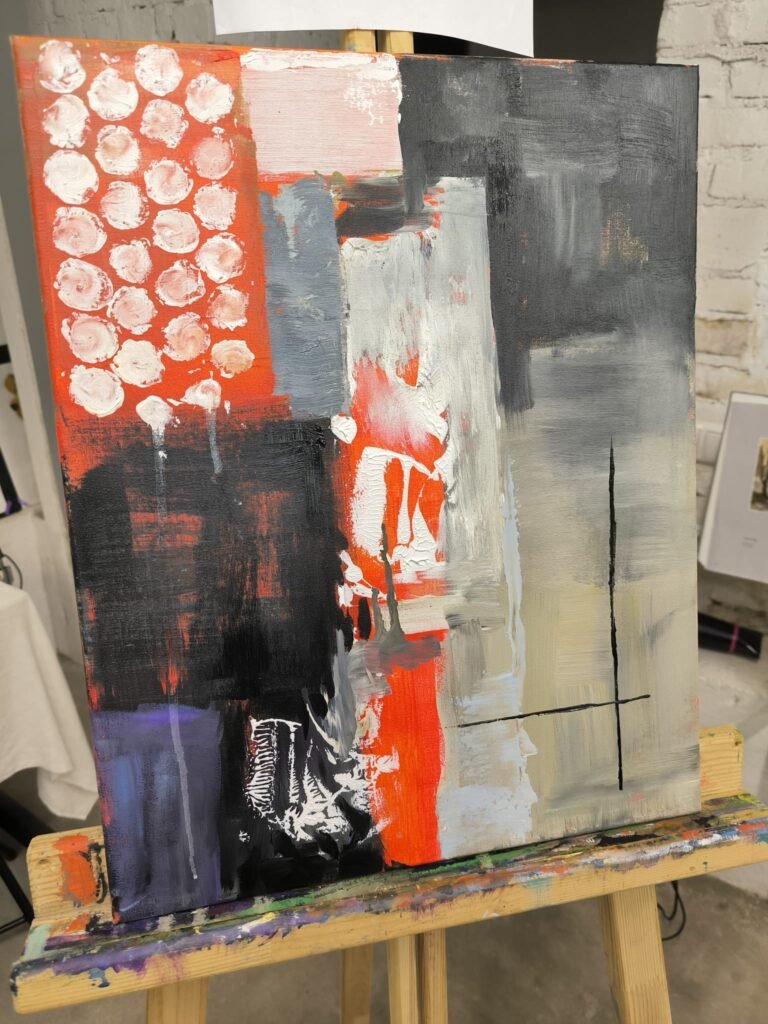
Here, the mandala is not meant to be a perfect decorative pattern. It can be freely interpreted, abstract, and even unfinished.
It is precisely the incompleteness that often reflects:
- personal growth
- openness to change
- creative development process
In the Paintnprogress.art approach, the mandala is not created as a precise technical ornament. It is an intuitive form with geometric and abstract elements that reflect inner feelings and rhythm.
It becomes a visual meditation in motion.
Psychological benefits
Meditative painting helps:
- reduce stress and emotional overload
- to release tension in the body
- improve emotional self-regulation
- reconnect with your creative side
This practice shifts attention from an analytical mode of thinking to an intuitive one. The body enters a calmer state, and the mind gets a chance to relax.
It's not an academic learning process. Rather, it's a conversation with yourself through colors and shapes.
Paintnprogress.art — art as a continuous process
The central idea behind Paintnprogress.art is that art doesn't have to be rushed to completion. It lives and breathes in the process.
Each job is:
- a journey through experience
- imprint of a specific moment
- personal inner story
What is important here is:
- allow yourself to experiment
- accept mistakes as part of the process
- perceive incompleteness as a creative space
The unfinished part of the mandala symbolizes space for further growth, new thoughts, and continuation.
Just as man himself is always in motion and development.




Why is it worth trying meditative painting?
It is suitable for anyone who wants to:
- to relieve the mind
- to regain inner peace
- to restore creative freedom
- to be with oneself in silence
There are no categories of “right” or “wrong” in this practice.
There is no rating of “successful” or “failed”.
There is a process in which one surrenders to the experience of painting and observes what is revealed within it.