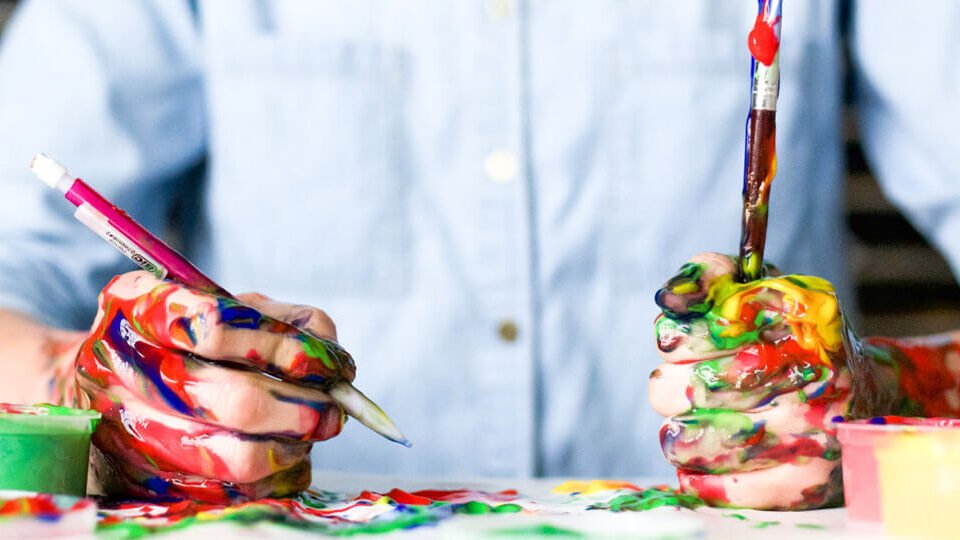
(crisis for a beginner and how to overcome it?)
A drop in motivation is a natural phenomenon in any creative process, especially when you have just started painting or exploring the world of art. Many beginners feel enthusiastic in their first lessons, but after a while, doubts, fatigue and the feeling that “maybe this is not for me” appear.
The good news is that a motivation crisis is not a reason to stop. It is a normal part of development, and with the right approach, it can be easily overcome.
In this article we will look at Why does creative exhaustion occur?, how to recognize it, and practical ways to stay motivated and not burn yourself out, starting his path in art.
👉 Sign up for your first lesson here: All available classes
1. Why do beginners most often “burn out”?
1.1. Expectations too high
Many people enter the studio with the idea that their first work must be excellent. But art is a process—not a quick result.
1.2. Comparison with others
Seeing someone else painting faster or more convincingly often makes a beginner lose motivation.
1.3. Incorrect work pace
Rapid waves of enthusiasm followed by complete creative silence quickly lead to exhaustion.
1.4. Perfectionism
The desire to do “perfectly right” paralyzes creativity and creates fatigue.
1.5 Not knowing where to start
Many beginners get confused by the wide selection of materials, techniques, and styles.
2. How to recognize that a motivation crisis is approaching?
If you notice these signals, know that it's time to slow down and take care of yourself:
- There is a feeling of "there is no point in continuing".
- Easily irritated by even small setbacks.
- It becomes difficult to get started — even if you have lots of ideas.
- You can't enjoy the process, even if the result is good.
- Painting begins to feel like a duty rather than a joy.
Beginners often think it only happens to them — but it's not. It's a completely normal experience.
3. How not to burn out? Practical steps for beginners
3.1. Reduce your demands on yourself
Art is not a marathon that you have to reach the finish line.
Learn to enjoy small, gradual improvements.
Tip: Force yourself not to redraw the work 20 times. Finish one, start the next.
3.2. Train creativity, not excellence
Creativity is a muscle—it gets stronger when used often and freely.
Try 10-15 minute exercises: quick sketching, mixing colors, testing brushes.
3.3. Work in shorter but regular sessions
Better 3 times a week for 30 minutes than once for 5 hours, after which there is a burnout.
3.4. Don't compare yourself to others in the studio
Everyone has their own pace, their own aesthetic, and their own path.
Comparison creates tension that kills creativity.
3.5. Introduce “creative rest days”
Just as athletes need rest days, creative people also need them.
You can watch inspiring content, go to a museum, or just go for a walk.
3.6. Allow yourself to make mistakes
The beginner's task is not to create a masterpiece—it's to learn the process.
Mistakes = progress.
3.7. Start with simple goals
For example:
- “I'm going to try a new brush today.”
- “I'll just paint the background tonight.”
- “I will learn to mix 3 new colors.”
Such goals are not tiring and are easy to complete.
3.8. Attend master classes or group lessons
Interaction with the teacher and other beginners helps to find:
- motivation,
- inspiration,
- support,
- structure.
This is one of the most effective methods for not losing creative joy.
4. When do you need a break — and when don't you?
Beginners often confuse fatigue with “I can’t do it, so I have to quit.”.
It is important to understand:
- A break is needed., if you feel physically or emotionally tired.
- No pause needed, if only fear or perfectionism is holding you back.
Sometimes just 1-2 days are enough for creativity to return.
5. How to regain motivation if it has already disappeared?
- Return to techniques that brought joy.
- Look at your first works - you will notice the progress.
- Invite a friend to a master class.
- Set yourself a "creativity challenge": 5 days - 5 small tasks.
- Remember that you are painting for yourself, not for the result.
Conclusion: A motivational crisis is not the end, it's part of the creative journey
Beginners often misunderstand that a drop in motivation does not mean that you "don't have talent.".
This means only one thing: you are evolving, and your mind is adapting to new creativity.
With the right methods you can:
- to keep the joy,
- develop skills,
- and grow as an artist despite the difficulties.
Creativity is not a linear path—it is an adventure where the most important thing is to keep going.